In this post, the professor discusses the effects of crystal oscillator aging and methods used to minimize their impact on performance
Key Effects of Aging on Timing Applications
Frequency Drift: As the oscillator ages, its frequency can increase or decrease, causing the system clock to run slightly faster or slower than intended. This is particularly problematic in systems where even minor deviations can accumulate into substantial timing errors over hours, days, or years.
Holdover Performance: In critical timing systems—such as in satellites, network infrastructure, and measurement equipment—oscillators often serve as backup clocks when external references (like GPSs) are unavailable. During these “holdover” periods, the local oscillator must maintain accurate timing. Aging-induced frequency drift can degrade holdover accuracy, leading to synchronization errors in networks or data loss in time-sensitive applications.
Long-Term Reliability: Over extended operation, the cumulative effect of aging can push the oscillator’s frequency outside acceptable limits for the application, necessitating recalibration, replacement or compensation mechanisms.
Environmental Sensitivity: Aging effects can be exacerbated by environmental factors such as temperature fluctuations and power cycling, further destabilizing timing performance.
Mitigation Strategies
Mitigation strategies include using oscillators with inherently low aging rates, implementing compensation algorithms, and designing systems to allow for recalibration or redundancy in timing sources.
To manufacture very-low-aging crystals, cleanliness and contamination control during the processing is most important. Next, the crystal must be sealed in an extremely hermetic environment, either in a resistance-weld or, even better, a cold-weld package. Additionally, lengthy initial burn-in at high temperature can accelerate the initial frequency changes.
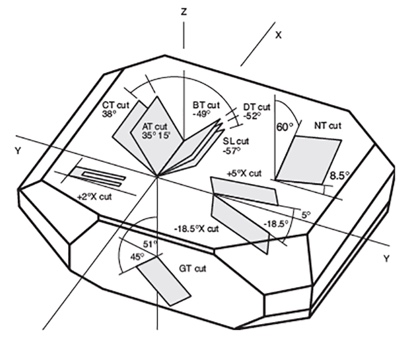
Pre-aging is another approach. Before shipment, precision crystals are often factory “pre-aged” to accelerate the initial rapid aging phase. This ensures that the oscillator achieves its specified aging rate more quickly in the field. High-quality, stress-compensated (SC-cut) or AT-cut crystals are chosen for their superior long-term stability and lower intrinsic aging rates, with SC-cut crystals offer better aging performance in crystal oscillators than typically used AT-cut types (Figure 1).
The aging process of crystals slows and improves over time, with the first months and years showing more change than subsequent time periods. For example, with standard crystal clock oscillators, where the quartz crystal is enclosed in the same environment as the rest of the oscillator circuitry, a typical aging rate might be ±1 to ±5ppm for the first year, and then ±0.5 to ±2ppm for subsequent years.
The standard military specification for quartz crystals, MIL-PRF-55310 (and its predecessor MIL-O-55310), carefully specifies crystal aging and calls for a 30-day aging test at an elevated temperature of 70 degrees C, with strictly defined limits on how much the frequency can change and still be acceptable. In addition, the military specifications give mathematical equations wherein the 30 days of aging data can be fitted to predict worst-case aging over longer time periods. At Q-tech, crystal oscillators intended for use in timing-critical applications are tested for compliance with MIL-PRF-55310.